
Why Do Some Truck Accident Cases Take So Long to Settle?
After a serious truck accident, waiting for an insurance settlement can be almost as frustrating as dealing with the accident itself. Medical bills keep arriving, time away from work creates financial pressure, and you may have no clear idea when your claim will be resolved.
Truck accident claims often take longer than ordinary car accident cases because there may be several responsible parties, extensive company records to investigate, complicated insurance arrangements, and serious injuries whose long-term effects are not yet known.
But not every delay is necessary, and a slow-moving claim does not always mean the insurance company is acting improperly. Understanding what is happening behind the scenes can help you recognize legitimate complications, ask better questions, and avoid decisions that could undermine your case.
Below, we explain the most common reasons truck accident settlements take time, what can cause unnecessary delays, and how an attorney may help move the claim toward resolution.

Why Truck Accident Settlements Can Take Longer Than Car Accident Claims
A collision involving a tractor-trailer or another large commercial truck may seem straightforward at first. One vehicle strikes another, injuries occur, and an insurance claim follows. But determining exactly what happened, who bears legal responsibility, and what compensation may be available can require considerable investigation.
Commercial trucking operations may involve drivers, motor carriers, vehicle owners, maintenance companies, and businesses responsible for loading cargo. Relevant evidence may also be scattered among those organizations.
When serious injuries are involved, another challenge emerges: the parties may not yet know the full extent of the injured person’s medical needs or future financial losses.
Here are six reasons a truck accident case may take longer than expected.
1. Investigating Federal and State Trucking Regulations Takes Time
Many commercial trucking operations are subject to federal safety regulations administered by the Federal Motor Carrier Safety Administration (FMCSA), along with applicable state requirements. Depending on the operation, those rules may govern driver qualifications, hours of service, inspections, vehicle maintenance, and cargo securement.
After a serious collision, investigators may need to determine which regulations apply, whether the driver or motor carrier complied with them, and whether any violation contributed to the accident.
That can involve reviewing electronic logging records, driver qualification files, inspection reports, maintenance histories, and company communications. Obtaining and interpreting those records may take time, particularly when several businesses are involved.
A regulatory violation does not automatically establish liability. The evidence must still connect the conduct in question to the collision and the resulting injuries.
For additional background, see our article on who regulates trucks and their drivers in North Carolina.
2. Several Parties May Share Responsibility for the Accident
In an ordinary two-car collision, liability may primarily concern the actions of the drivers. Commercial truck accidents can involve a wider range of potential defendants.
For example, a truck driver may have made an unsafe maneuver, but an investigation could also uncover inadequate vehicle maintenance, problems with cargo securement, or negligent practices by another business associated with the truck.
Depending on the facts, investigators may need to examine the conduct of:
- The truck driver — including speed, attention, fatigue, and compliance with applicable safety requirements.
- The motor carrier — including relevant hiring, supervision, operational practices, and potential responsibility for the driver’s conduct.
- The vehicle owner or maintenance provider — where equipment condition or improper maintenance may have contributed to the collision.
- A cargo-loading company — if improper loading or securement played a part.
- A vehicle or component manufacturer — when evidence points to a potentially defective product.
Not every truck accident involves multiple liable parties. However, determining which organizations actually bear responsibility may require separate records, witnesses, insurance information, and expert analysis.
When defendants dispute their respective roles, resolving those disagreements can add time to the case.
3. Important Truck Accident Evidence May Be Difficult to Obtain
Some of the strongest evidence in a truck accident claim may be held by the trucking company or another business rather than by the injured person.
Depending on the equipment and circumstances, relevant information may include vehicle electronic data, dashcam footage, driver duty-status records, dispatch messages, inspection reports, and maintenance documents.
This evidence can be especially important when the parties disagree about speed, braking, driver fatigue, mechanical failure, or what happened immediately before impact.
Why Early Evidence Preservation Matters
Some electronic information may be overwritten during ordinary vehicle operations, while physical evidence can change when damaged equipment is repaired or returned to service.
An attorney may send an evidence-preservation request, sometimes called a spoliation letter, identifying records or physical materials that should be retained because of a potential legal claim.
A preservation letter does not automatically give the injured person access to every requested record. Obtaining evidence may require cooperation, formal discovery, or court procedures.
Our article What Is a Spoliation Letter After a Truck Accident? explains why these requests can be important.
4. Serious Injuries May Require Long-Term Medical Evaluation
 One of the most significant reasons a truck accident settlement may take time has little to do with trucking regulations or insurance negotiations. It concerns the injured person’s medical recovery.
Because large commercial trucks are substantially heavier than passenger vehicles, some collisions cause severe injuries. However, not every truck accident results in catastrophic harm, and the seriousness of an injury must be assessed individually.
Injuries involving the spine, brain, bones, or internal organs may require surgery, rehabilitation, specialist care, or ongoing treatment. Doctors may need time to evaluate whether a patient is likely to recover fully or experience lasting limitations.
Those medical developments can affect the assessment of damages, including:
- Medical expenses already incurred.
- Reasonably anticipated future treatment.
- Income lost during recovery.
- Potential reductions in future earning capacity.
- Physical pain, suffering, and other legally recoverable losses.
Settling too early may mean resolving the claim before these consequences are reasonably understood. A settlement commonly involves releasing further claims arising from the accident, which can make an early agreement difficult or impossible to revisit later.
Do You Have to Finish All Medical Treatment Before Settling?
Not necessarily. Some claims resolve while medical treatment continues, particularly when reliable evidence allows future needs to be evaluated. In other cases, waiting for a clearer prognosis may be appropriate.
The decision depends on the medical evidence, available insurance coverage, liability issues, and the terms of the proposed settlement.
A lengthy recovery does not mean that a lawsuit should automatically be postponed. Filing deadlines still apply even when treatment is ongoing.
5. Insurance Negotiations Can Become Complicated
Commercial trucks may be covered by insurance arrangements that differ from those typically involved in passenger vehicle accidents. Depending on the operation, there may be several policies, coverage layers, or disputes about which insurer is responsible for a particular loss.
Insurers also investigate liability and damages independently. They may dispute medical causation, the reasonableness of treatment expenses, the extent of lost earnings, or an injured person’s account of the collision.
These disagreements can slow negotiations, especially when the claim involves substantial damages or conflicting expert opinions.
Does a Delayed Settlement Mean the Insurance Company Is Acting in Bad Faith?
No. A delay may result from legitimate investigative, medical, or procedural issues. However, some delays may warrant closer scrutiny, particularly when requests for information are repeatedly ignored, explanations change without clarification, or negotiations stall without an apparent reason.
Whether an insurer’s conduct violates applicable law depends on the particular facts and legal standards. Delay alone is not sufficient to establish bad faith.
An attorney can help identify what remains unresolved and determine whether additional documentation, negotiations, or formal legal action may be appropriate.
6. North Carolina’s Contributory Negligence Rule Can Complicate Fault Disputes
North Carolina generally follows the doctrine of contributory negligence. In an ordinary negligence claim, an injured person’s own negligence may prevent recovery if that negligence contributed to causing the injury, subject to recognized exceptions and other applicable legal principles.
That makes evidence about the actions of both drivers especially important.
For example, a trucking company’s insurer might contend that a passenger vehicle driver was following too closely, traveling too fast, or failed to maintain a proper lookout. The injured person’s attorney may need to examine roadway evidence, witness accounts, vehicle data, and accident reconstruction findings to evaluate those allegations.
An insurer’s assertion of contributory negligence is not the same as a legal determination. Establishing the relevant facts may require additional investigative work or expert assistance.
For a more detailed discussion, read How Contributory Negligence Affects North Carolina Accident Claims.
What Happens If the Truck Accident Case Cannot Be Settled?
Some truck accident claims resolve through negotiations without a lawsuit. Others require litigation when the parties cannot agree about responsibility, the extent of the injuries, or an appropriate settlement amount.
Once a lawsuit is filed, the parties may exchange relevant evidence through discovery. This can involve written questions, document requests, depositions, medical evidence, and expert testimony.
Complex cases may require accident reconstruction specialists, medical experts, or professionals capable of interpreting electronic vehicle data.
Litigation can extend the timeline, but it may also provide procedures for obtaining evidence and resolving disagreements that could not be settled informally.
Not every lawsuit reaches trial. Some cases settle during discovery, mediation, or later stages of litigation.
How Long Does a Truck Accident Settlement Usually Take?
There is no dependable timetable that applies to every North Carolina truck accident claim.
A case involving relatively clear liability and injuries that resolve quickly may progress differently from one involving permanent disability, disputed responsibility, and several commercial defendants.
Factors influencing the timeline include the time needed to obtain records, the injured person’s medical condition, the availability of witnesses and experts, negotiations between the parties, and whether litigation becomes necessary.
Instead of relying on an advertised average settlement time, ask which issues remain unresolved in your particular case and what steps are being taken to address them.
Can You Speed Up a Truck Accident Claim?
Although some delays are outside an injured person’s control, several practical steps may help prevent unnecessary complications:
- Obtain appropriate medical care and keep records of treatment and work restrictions.
- Preserve accident photographs, witness information, and relevant correspondence.
- Provide accurate information about prior injuries, medical history, and lost earnings when requested through appropriate channels.
- Respond promptly to reasonable requests for documents or information.
- Ask your attorney which matters are holding up the claim and what the next procedural step will be.
These steps cannot guarantee a faster settlement, but they can help ensure that avoidable documentation problems do not create additional delays.
Don’t Let Settlement Delays Cause You to Miss a Filing Deadline
It is important to distinguish the time spent negotiating a settlement from the legal deadline for filing a lawsuit.
Under N.C. Gen. Stat. § 1-52, many North Carolina personal injury lawsuits are subject to a three-year statute of limitations, although the applicable deadline can vary with the type of claim and other circumstances.
Negotiating with an insurance company does not necessarily suspend that deadline. An injured person should therefore seek advice about the relevant filing period even if discussions appear to be progressing.
Questions About a Delayed Truck Accident Settlement?
If you were injured in a collision with a commercial truck and your claim is taking longer than expected, it may help to understand whether the delay involves medical evidence, responsibility for the accident, insurance coverage, or the litigation process.
Kellum Law Firm represents injured individuals and families throughout North Carolina. Our attorneys can review the circumstances of your accident, explain the legal issues affecting your claim, and discuss the available options.
Learn more about our North Carolina truck accident lawyers, or request a free case evaluation.
Receive A Free Case Evaluation – No Obligation
~ RELATED CONTENT ~

What is a Salvage Title and Does It Affect My Payout in a Car Accident Claim?

Why Do Some Truck Accident Cases Take So Long to Settle?
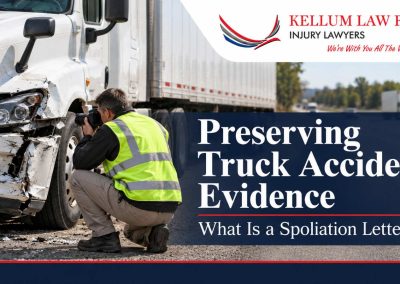
Preserving Evidence After a North Carolina Truck Accident: What Is a Spoliation Letter?
